7 weeks pregnant: symptoms and baby development
The face is taking shape.
First trimesterMonth 25 min read
By Solesia, from public clinical guidanceUpdated
You are thirsty more often, and warmer, and at night you can feel your own pulse in the pillow. Your body is learning to run on more: the amount of blood you carry is climbing toward about half again what it was, and your heart is working harder to move it. That is what those small sensations are. Your baby is putting a face together this week, the first folds of eyelids, the two dents that become nostrils, ears taking shape low on the head. None of it can be seen from the outside, and yet you might feel, for the first time, that you are carrying someone.
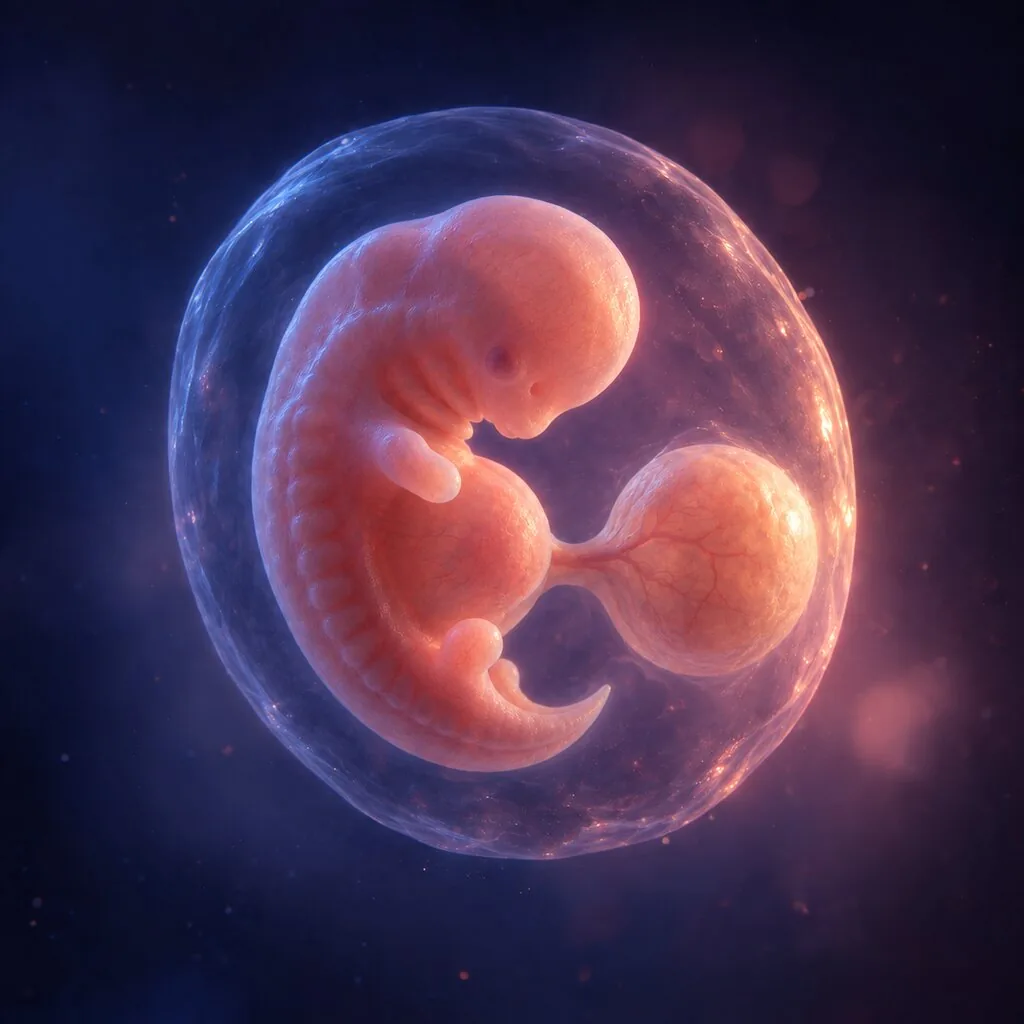
How big is your baby at 7 weeks

About the size of a blueberry
0.4 in long·under 0.1 oz
Baby development at 7 weeks
At 7 weeks your baby measures about 0.4 inches, the size of a blueberry, still curled so tightly that the head nearly touches the tail. The arm buds have grown into paddles with a flat plate at the end, and inside each plate the bones of a hand are being laid down, though the fingers are not separate yet. The legs are a few days behind, as they will be all the way through.
The face is gathering its parts. Two pits on the front of the head are deepening into nostrils, the eyes have a lens and a dark pigment behind it, and the folds that will become eyelids are just beginning. The ears start as small hollows on the sides of the head and the inner ear, the part that hears and balances, is forming behind them.
Inside, the heart is dividing into left and right, and the umbilical cord is now a real cord, carrying blood between them and the growing placenta. The kidneys have started, in their third and final version; the first two came and went in the last fortnight. The little tail is shrinking and will be gone within a couple of weeks.
Your body at 7 weeks
Being thirstier than usual is expected. Your body is making extra plasma, the watery part of blood, faster than it makes red cells, and it needs water to do it. Eight to ten glasses of fluid a day is a fair target, more in heat, and it counts milk, soups and decaf tea. Pale urine is the simple check that you are getting enough.
Feeling warm, or noticing a flush in your face and a quicker pulse on the stairs, is expected too. More blood means more heat moving to your skin and a heart that is already working harder. Light layers, a fan at night and water within reach make it easier. Your uterus is about the size of a lemon, still tucked behind your pubic bone, so there is no bump yet.
Cravings and aversions can be sharp now. A food you ate every day can suddenly be impossible, and something odd, sour or salty, can be all you want. Nobody knows exactly why, and there is no need to fight it: eat what stays down, and let a prenatal vitamin fill any gaps for a few weeks.
Common pregnancy symptoms at 7 weeks
- Thirst. Your blood volume is rising and needs water to do it. A bottle within reach all day.
- Feeling warm or flushed. Extra blood near the skin. Light layers and a cool room at night.
- Nausea. Hormones and a slow stomach. Eat something small before you feel empty.
- Food aversions and cravings. Taste and smell reset by estrogen. Eat what works; the vitamin covers the rest.
- Sore breasts. More blood flow and growing glands. A soft bra, and a size up if needed.
- A metallic taste. Hormones on your taste buds. Citrus, sour candy and brushing your tongue help.
- Thicker, shinier hair. Estrogen keeps hairs in the growing phase longer. Enjoy it; it evens out after birth.
When to call your provider at 7 weeks
Itching that seems to be everywhere, with no rash, is unusual this early. Mention it to your provider.
Two things are worth a same-day call at any point in pregnancy: bleeding that is more than spotting, and pain that is severe or does not ease. From the second trimester, add fluid leaking and any change in your baby’s usual pattern of movement. You do not need to be sure something is wrong to call; that is what the number is for.
What to do at 7 weeks
- Water and food that stays down. Aim for eight to ten glasses of fluid a day. If nausea makes water hard, try it very cold, fizzy, or with lemon, and sip through the day instead of drinking a glass at once.
- What to leave off the plate. Unpasteurized milk and soft cheeses, deli meats unless heated until steaming, raw or undercooked meat, fish and eggs, and high-mercury fish like swordfish and king mackerel. Everything else is on.
- Getting ready for the first visit. Note the first day of your last period, your cycle length, any previous pregnancies, and the health history on both sides of the family. Write down the questions as they come to you; they vanish in the room.
- Folic acid, still. Keep the 400 mcg going every day through at least 12 weeks. If nausea makes the prenatal vitamin hard to keep down, take it at night or with food, or switch to a gummy for now.
Common questions at 7 weeks
When will I start showing?
In a first pregnancy, usually between 12 and 16 weeks, when the uterus rises out of the pelvis. In a second or later pregnancy it can be earlier, because the muscles have stretched before. Any softness now is bloating; the uterus is still hidden behind your pubic bone.
Is it normal to be so thirsty at 7 weeks pregnant?
Yes. Your blood volume is rising quickly and the extra fluid has to come from somewhere, so your body asks for more water. Drink to thirst and aim for pale urine. On its own it is an ordinary part of the first trimester; with peeing very large amounts or blurred vision, mention it to your provider.
Can I eat sushi while pregnant?
Cooked sushi and vegetable rolls are fine. Raw fish carries a small risk of parasites and bacteria that pregnancy makes harder to fight off, so it is the raw pieces that are best skipped for now. Low-mercury fish like salmon, shrimp and cod, cooked through, are good to eat two or three times a week.
Written from public clinical guidance, including NHS: Week 7, ACOG: How your baby grows, ACOG: Changes in your body, ACOG: Nausea and vomiting and NHS: Morning sickness. This page is general information, not medical advice, and does not replace your provider.